Begin with a precise reading question
A report about children in military detention may contain legal analysis, accounts of individual experiences, descriptions of procedures, and recommendations for change. Those forms of information serve different purposes. Before reading closely, write down what you want to understand: the procedure during a particular period, the evidence supporting a finding, or the progress recorded after a recommendation.
This article offers a reading method, not an assessment of present detention conditions. Its historical example is UNICEF's February 2015 update, which covers developments from March 2013 through November 2014. That document describes engagement with Israeli authorities concerning children in military detention and uses international child-rights instruments as reference points. Its publication date and reporting period are part of the evidence, not details to discard. [1]
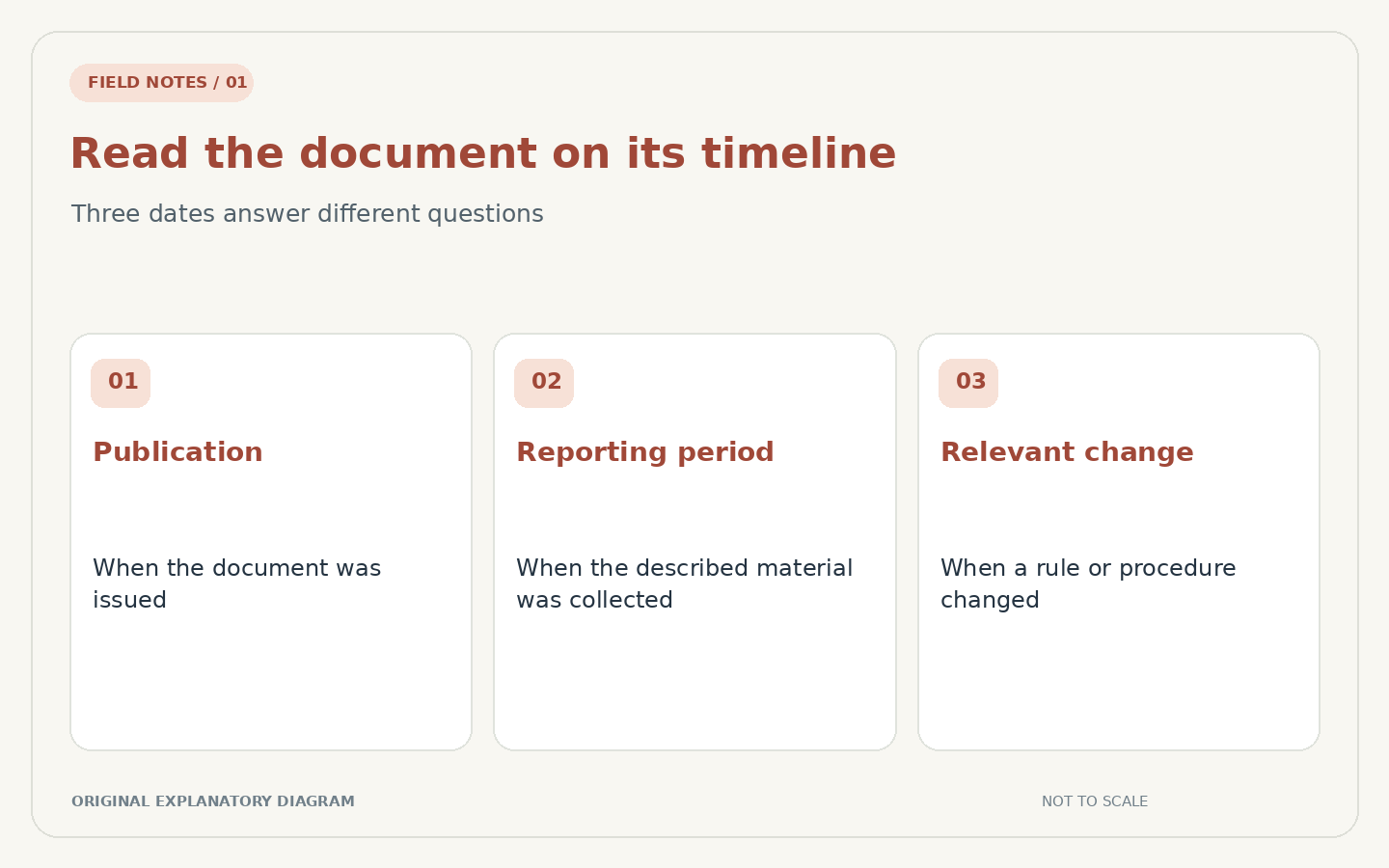
Put three dates on the page
Start a reading note with the publication date, the period studied, and the date of any procedure or legal change being discussed. A document published after a change may still describe experiences from before it. A later website upload does not necessarily mean that the research itself has been updated. Keeping these dates visible prevents a historical account from becoming an accidental present-tense assertion.
When comparing two reports, ask whether they cover overlapping periods and the same stages of detention. One might discuss interviews conducted over several months; another might describe a newly announced policy. These documents can be relevant to each other without measuring the same thing. Label the relationship explicitly before deciding that the later publication confirms or contradicts the earlier one.
Draw a process before judging it
Create a simple timeline of the stages addressed by the report: initial apprehension, questioning, court proceedings, detention, and release or transfer. Add only stages the document actually discusses. Under each, note which authority or professional role is described and what information the reader would need to understand a child's experience at that point.
This exercise exposes gaps that a broad summary can hide. A report may provide substantial detail about questioning while saying little about continuity of education or care after release. The absence of information should remain an unanswered question. Do not fill it with an assumption that a service was available, unavailable, effective, or harmful. A timeline is a way to organize evidence, not manufacture it.
Distinguish an account from a conclusion
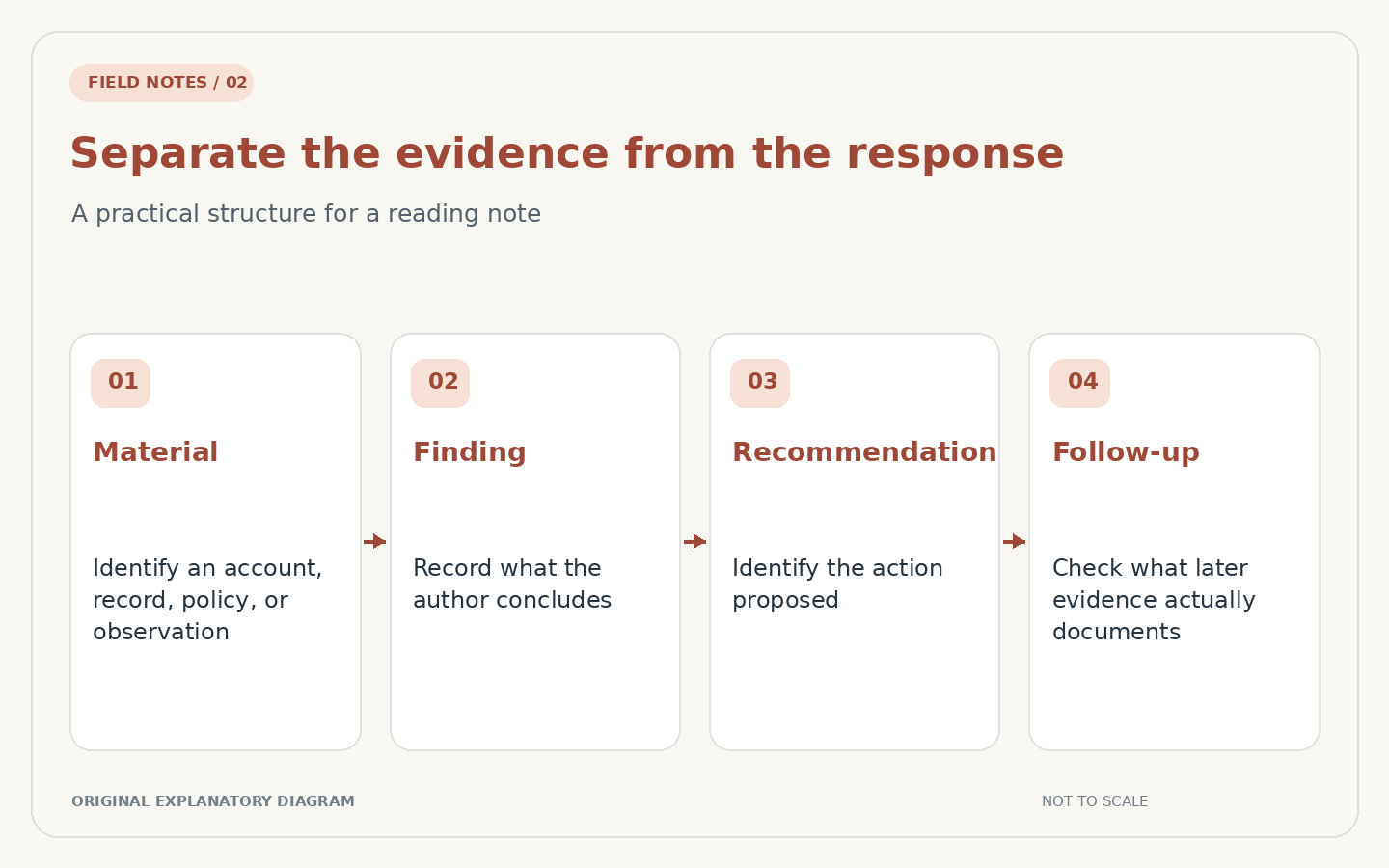
Use separate columns for the material presented and the author's interpretation. The first column might identify an interview account, an observed proceeding, an administrative record, or a written policy. The second might record the report's finding or recommendation. Include the page reference so that another reader can follow the distinction without trusting your memory.
This does not require treating every source as equally informative. Instead, ask what each can establish. A policy describes a formal rule; it does not, by itself, show consistent implementation. A documented experience can reveal a serious issue without providing a population-wide rate. A recommendation identifies a proposed response; its presence does not prove that the response has subsequently occurred. Preserve these limits in any summary.
Keep rights questions visible
The Convention on the Rights of the Child addresses children's participation, privacy, healthcare, and safeguards surrounding deprivation of liberty. Article 37 sets out a last-resort and shortest-appropriate-period standard for detention, alongside protections concerning treatment, family contact, and legal assistance. These provisions supply distinct questions for a reader; determining a particular legal claim requires the relevant facts and applicable legal analysis. [2]
Make a rights-question column beside the timeline. This encourages attention to more than the outcome of a proceeding. The way information was explained, access to assistance, and opportunities to raise a concern may each require separate examination. Avoid turning a complicated document into a single score that conceals which issue is supported, unresolved, or outside the report's scope.
Read health passages with care
A health section can include reported symptoms, an examination finding, a diagnosis, or a description of access to care. Record which kind of statement appears. A child's report of pain and a clinician's diagnosis are different pieces of information; neither should be silently rewritten as the other. If a report does not explain how a health conclusion was reached, preserve that uncertainty.
Ask practical continuity questions as well. Does the document describe who could request care, how an existing care need was communicated, or what happened when responsibility changed? These are questions for examining a report, not assertions that a particular service failed. They connect the legal and procedural account with the ordinary work needed to support a child through changes of setting.
Examine what follow-up actually shows
UNICEF's 2015 publication is explicitly an update on engagement and actions, rather than a timeless description. [1] When reading any follow-up document, distinguish a discussion, a commitment, a revised written procedure, and evidence about implementation. Each may represent a different stage of work. A summary that calls all four a completed reform gives the reader less information than the original record.
A useful note might identify the recommendation, the response reported by the author, and the remaining question. Keep this format descriptive. If the report says that a measure was proposed, use proposed. If it describes a limited implementation, retain that limit. Clear verbs make the comparison more accurate without requiring a reader to adopt a predetermined judgment.
Write about children without reducing them
When summarizing, use language that distinguishes an allegation, a charge, a finding, and an outcome. Do not infer guilt from detention or treat a child as a symbol for every child described in a report. Avoid reproducing identifying details merely because an older document contains them. A public summary can explain a procedural question without retelling an individual child's experience.
For a group discussion, prepare questions about the document rather than invitations to speculate about a child's character. Ask how the evidence was collected, which dates matter, or what information would resolve an uncertainty. This keeps attention on the material available for review. It also leaves room for participants to disagree about interpretation without making personal assumptions about the children concerned.
Leave a useful reading record
Finish with a short record containing the document's scope, its reporting period, the stages addressed, its principal findings, and the questions it leaves open. Link each finding to a page in your private working notes. Keep quotations brief and distinguish the author's words from your explanation. If the record will be shared, review it for unnecessary personal details.
The strongest reading note is one that another person can check and update. It should make clear what the report establishes within its scope and what requires newer or different evidence. This method keeps children's rights and practical needs in view while respecting the distance between a historical publication, a current situation, and an individual child's circumstances.
Sources
- Children in Israeli Military Detention: Observations and Recommendations, Update No. 2, February 2015 — UNICEF
- Convention on the Rights of the Child — United Nations treaty, published by UNICEF